|
 |
|
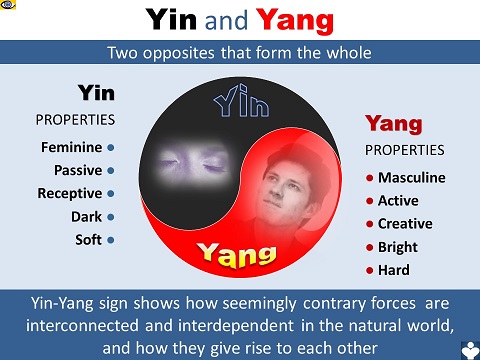
The Two Polar Energies
Yin and Yang represent two fundamental forces
that create and harmonize the Universe by their interaction. These two
opposite, conflicting forces found in every action. They symbolize the two
polar energies that, by their fluctuation and interaction, are responsible
for the dynamic universe.
|
|
| |
The Two Polar Energies
Yin and Yang represent two fundamental forces
that create and harmonize the Universe by their interaction. These two
opposite, conflicting forces found in every action. They symbolize the two
polar energies that, by their fluctuation and interaction, are responsible
for the dynamic universe. The notion means that the reality consists of
relationships between opposite and opposite principles. |
|
| |
The
State of Success

In the state of peace,
good fortune, and success (I-Ching,
Hexagram 11), Yin, the
Receptive, which moves downward, stands above;
Yang, the
Creative,
which moves upward, is below. Hence their influences
meet and are in harmony, so that all living things
bloom and prosper. This is a the state of peace,
good fortune, and success.
>>> |
|
| |
Origin of the Yin-Yang Concept
The concept yin-yang stems from the Book of
Change (I-ching), a Chinese book of wisdom and oracles, dating from the
transition period between the Yin and Chou dynasties. The essential
philosophy of the Book of Change is based on
Confucianism, but there are
also
Taoist ideas present. It is based on the idea of two polar energies, by
whose activities all things are brought about and come into being.
Initially, these two energies were simply called the light and the dark, but
later were referred to as yin and yang. The interaction of yin and yang
produces change, which is to be understood as the movement of the Tao.
Yin and yang are polar manifestations of the
Tao – the supreme ultimate. The One is divided through the creative powers
of the Tao into two opposite energetics and dualities, which then give birth
to "the ten thousand things", their concrete manifestations being Earth and
Heaven.
|
|
| |
5 Basic Elements
The Yang and Yin operate in the universe
primarily through the agency of the
Five Basic Elements: Earth (Saturn), Water (Mercury), Metal (Venus),
Wood (Jupiter), and Fire (Mars). These elements under the guidance
of the five planets form, with the Sun and Moon, the seven rulers.
Each of the elements may also be Yang or Yin, so that combinations
of all these could produce broad number possibilities and
astrological alternatives. Each, of course, has its symbol which can
be, and often was, incised into jade...
More |
|
| |
The Manifestation of Continuous Change
From the
intermingling of yin and yang arise the five elements – water, fire,
wood, metal, and earth
– the five
phases of transformation, or five energies, that determine the
course of natural phenomena. This manifestation of all phenomena is
seen as a cyclic process, an endless coming into being and passing
away, as everything, upon reaching an extreme stage, transforms into
its opposite. The underlying shared characteristic of yin and yang
therefore consists in giving rise to this continuous change, which
is said to be the movement of the Tao. |
|
|